Waterproofing material guide
Bitumen membrane waterproofing provides durable protection for flat roofs, concrete slabs and foundations when laps, terminations, corners and protection layers are installed with proper workmanship and surface preparation.

Material selection guide
Bitumen membrane waterproofing has been used in the UAE for decades because it handles heat well, resists ponding water and provides a thick, durable barrier when installed correctly. Most property owners searching for bitumen waterproofing are dealing with flat roof leaks, slab seepage or foundation dampness. This system is the workhorse for Roof Waterproofing Dubai, Basement Waterproofing Dubai and foundation protection where a robust, physically thick barrier is needed.
Modern bitumen roofing in the UAE uses SBS-modified or APP-modified polymer membranes rather than plain oxidised bitumen. SBS adds elasticity so the sheet flexes with daily thermal movement instead of cracking, while APP adds heat resistance for very hot exposed roofs. Choosing the right modifier for the roof type is one of the details that separates a 5-year repair from a 15-year system, and it is a decision we make after inspecting the roof, not before.
Where it fits
Large horizontal areas are ideal for sheet membrane because the material can be rolled out, lapped and torched into a continuous barrier. Podium decks that carry landscaping or parking benefit from the physical toughness of a two-layer bitumen system under screed.
Below-grade structures need a barrier that resists constant water pressure and saline groundwater. Bitumen membrane applied to the foundation walls and raft, then protected before backfill, is a proven approach for Dubai basements and lift pits.
Bitumen detailing at parapets, gutters and drainage outlets seals the junctions where most roof leaks actually start. Reinforced corners and correctly formed upstands are essential.
Placing insulation and ballast above the membrane shields the bitumen from UV and foot traffic, extending its life considerably on exposed UAE roofs.
For exposed terraces with high movement or intricate detailing, a polyurethane liquid coating often performs better. For wet areas and water tanks, cementitious waterproofing is more suitable. We recommend bitumen only where its strengths match the surface.
Installation quality
The slab must be clean, dry and primed with bitumen primer for the membrane to bond. Applying membrane over dust, moisture or laitance is the most common cause of early debonding and blistering we find on failed UAE roofs.
Side and end laps must meet the minimum width and be fully torched so the bitumen bleeds out at the edge, confirming a sealed joint. Under-torched or cold laps open up under thermal cycling.
Internal and external corners, pipe penetrations and drains receive an extra reinforcing patch. These stress points fail first if not detailed properly.
Even a perfect membrane fails if water ponds. We verify falls to drains and correct slope with screed where ponding is found before laying the membrane.
Related pages
UAE climate guidance
Dubai summers push roofing materials to their limits. A bitumen membrane on a flat roof can reach surface temperatures above 70°C when unprotected. Quality SBS-modified membranes are formulated with elastomers that keep the sheet flexible even after repeated heating and cooling cycles. This flexibility prevents the brittleness that causes oxidised bitumen to crack after only a few seasons.
Ultraviolet radiation breaks down the surface of exposed bitumen, causing it to dry out and powder. A mineral-granule cap sheet or a protective screed is therefore not optional in the UAE, it is a longevity requirement. Regular dust accumulation can also mask early cracks, so we recommend an annual visual check after sandstorms.
Concrete slabs expand during the day and contract at night. A rigid membrane would tear at the laps and corners. SBS-modified bitumen has the memory and elasticity to follow this movement, provided laps are fully bonded and the detailing around upstands and penetrations is done with reinforced patches.
Flat roofs are common in the UAE, and they only stay dry if drains are clear. Ponding water accelerates the degradation of any membrane and allows algae growth. We always address falls and drainage before installing a new bitumen layer, because the best membrane cannot outperform a poorly drained slab.
Value and durability
Bitumen membrane pricing depends on the thickness of the cap sheet, whether a base sheet is used, the condition of the existing substrate, the type of protection layer, and the amount of detailing required for pipes, drains and parapets. A single-layer budget installation may appear cheaper but often lasts only half as long as a properly designed two-layer system.
When installed over a clean, primed slab and protected from UV, a two-layer SBS-modified bitumen system can last 10 to 15 years. Exposed single-layer systems with no protection typically require major maintenance within 5 years, especially on south-facing roofs.
DryGuard.ae provides a workmanship warranty for every bitumen installation. We cover leaks that originate from defects in our installation, including failed laps, under-detailed corners and poor priming. The warranty is valid only when the protection layer is installed as specified and when the client maintains drainage paths and has an annual inspection.
If you notice blisters, cracked cap sheets, loose mineral granules, or water stains on the ceiling below, the membrane is likely reaching the end of its service life. Early intervention can usually be solved with a local repair, while delayed action often requires a full overlay and structural repairs.
Service
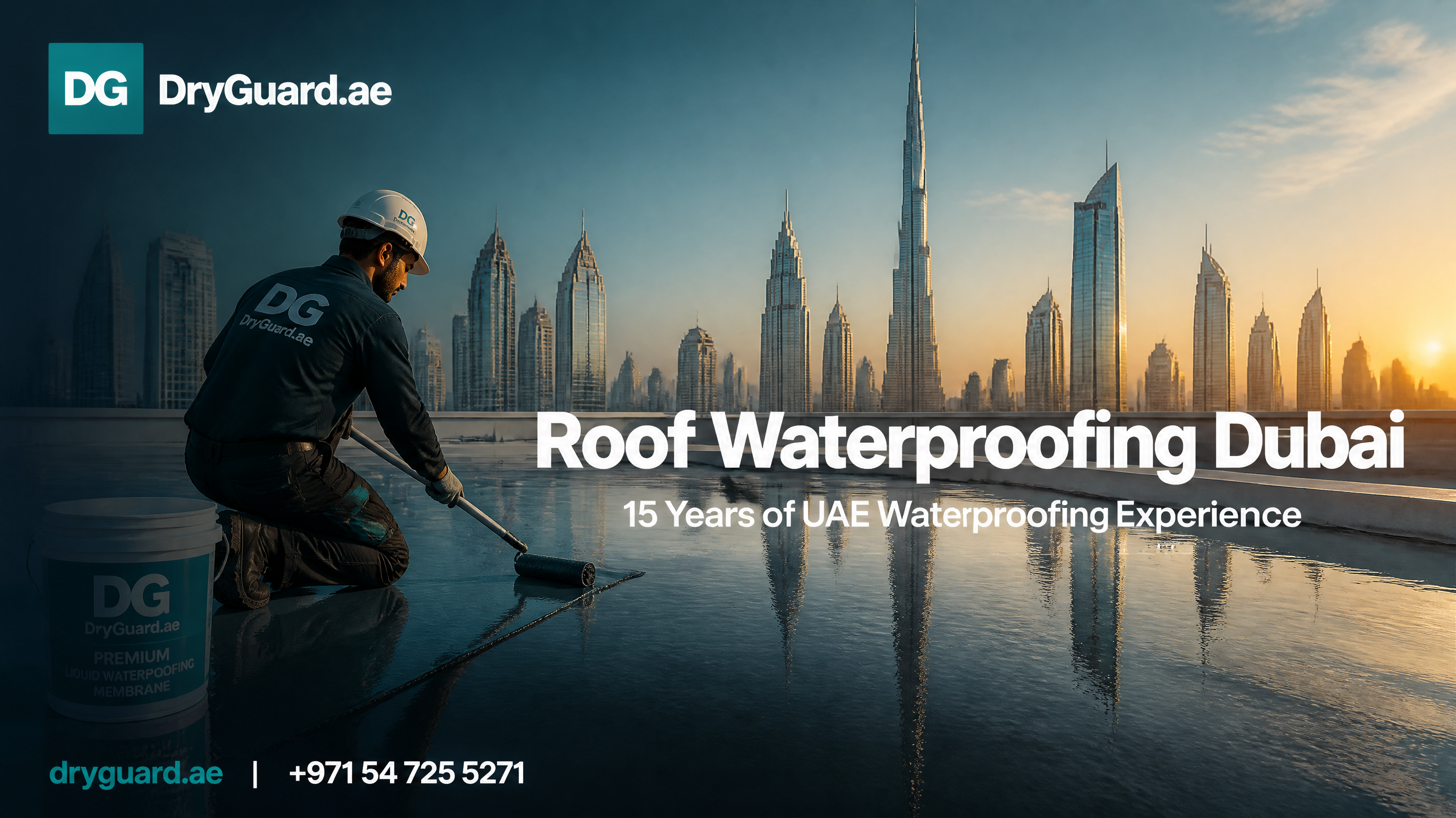
DryGuard.ae installs bitumen membrane systems for flat roofs, podium decks and basements across Dubai and the UAE. We start with a full inspection of the existing surface, checking for moisture, cracks, and drainage. This ensures the membrane is applied over a sound substrate that will hold the bond for years.
Material selection is matched to the exposure. Exposed roofs receive a UV-stable mineral finish cap sheet, protected roofs may use a two-layer system, and below-grade applications use torch-on membranes with a protection board before backfill. We follow manufacturer specifications for each product.
Protection layers are specified as part of the system, not as an optional extra. Tiles, pavers, screed, or a reflective coating protect the membrane from UV and mechanical damage. We also detail every drain, upstand, and penetration with reinforced patches.
Every bitumen installation is covered by a written workmanship warranty. We provide the client with a completion report, photographs, material details, and maintenance recommendations. Annual inspections are recommended to keep the system performing through Dubai's extreme heat.
Contact
Call +971 54 725 5271 for a free bitumen membrane assessment. We inspect your roof, basement, or slab and recommend a two-layer system with the right protection for the UAE climate.
Our written quotations include material specifications, thickness, and warranty terms. We work across Dubai, Abu Dhabi, Sharjah, and all emirates.